 Pin It
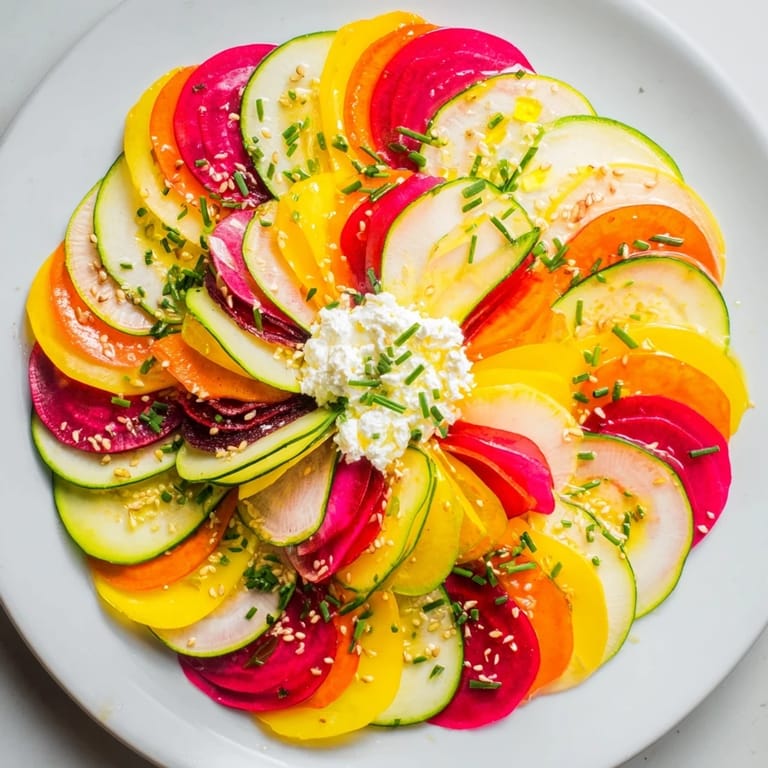
 I discovered this dish during a lazy afternoon at a farmers market in Provence, watching an artist arrange vegetables with the same care she'd give a painting. The woman selling heirloom tomatoes showed me how she sliced them paper-thin, and something clicked—why couldn't a salad be art? I brought the idea home and spent an entire evening arranging colorful vegetables in perfect circles, feeling like a kid with a kaleidoscope. My partner walked in, stopped mid-sentence, and we just stood there admiring it before eating. That's when I knew this dish was special.
I made this for my mother's birthday dinner, and watching her face when she saw the sunburst arrangement made all those careful knife work minutes worthwhile. She called it too beautiful to eat—but we did anyway, and she went back for seconds. That's the magic of this dish: it delivers on the promise of its presentation.
Ingredients
- Golden beet: Its warm, earthy sweetness is the perfect counterpoint to the tang of goat cheese. I learned the hard way that peeling them before slicing keeps your hands from turning violet for a week
- Red beet: This is your visual anchor—those deep burgundy slices create dramatic contrast that makes the whole arrangement pop
- Zucchini: The mild, delicate flavor lets other vegetables shine, and its pale green feels fresh against the jewel tones
- Yellow squash: Think of this as the sunshine center that ties the color story together
- Watermelon radish: This is the showstopper ingredient with its pink and white striped interior—slice it carefully to reveal the hidden pattern
- Carrot: Orange brings warmth and sweetness, and its natural sugar caramelizes beautifully when it meets the dressing
- Goat cheese: Creamy, tangy, and surprisingly earthy—it's the grace note that brings everything into harmony
- Crème fraîche: A little dollop transforms the goat cheese into something almost cloud-like in the center
- Extra-virgin olive oil: Don't skimp here; it's what carries the honey's sweetness across every slice
- Lemon juice: Fresh and vital—bottled just doesn't have the same brightness that wakes up the vegetables
- Honey: A whisper of sweetness that balances the earthiness of the beets and the tartness of the cheese
- Fresh chives: They're like the final brush stroke, adding a gentle onion note without overwhelming anything
- Toasted sesame seeds: A textural surprise that makes every bite interesting
Tired of Takeout? 🥡
Get 10 meals you can make faster than delivery arrives. Seriously.
One email. No spam. Unsubscribe anytime.
Instructions
- Slice everything paper-thin:
- This is where patience becomes your greatest tool. Whether you're using a sharp knife or a mandoline, aim for slices so thin you could almost read through them. The beets especially need finesse—they're sturdy enough to handle it, and those delicate slices will fan beautifully. Use a guard if you have one; I learned that lesson the hard way.
- Create your focal point:
- Place that small bowl or ramekin right in the center of your platter. This is your North Star—everything radiates outward from here. I like to imagine I'm building a mandala, where every slice has its purpose in the greater design.
- Begin your sunburst:
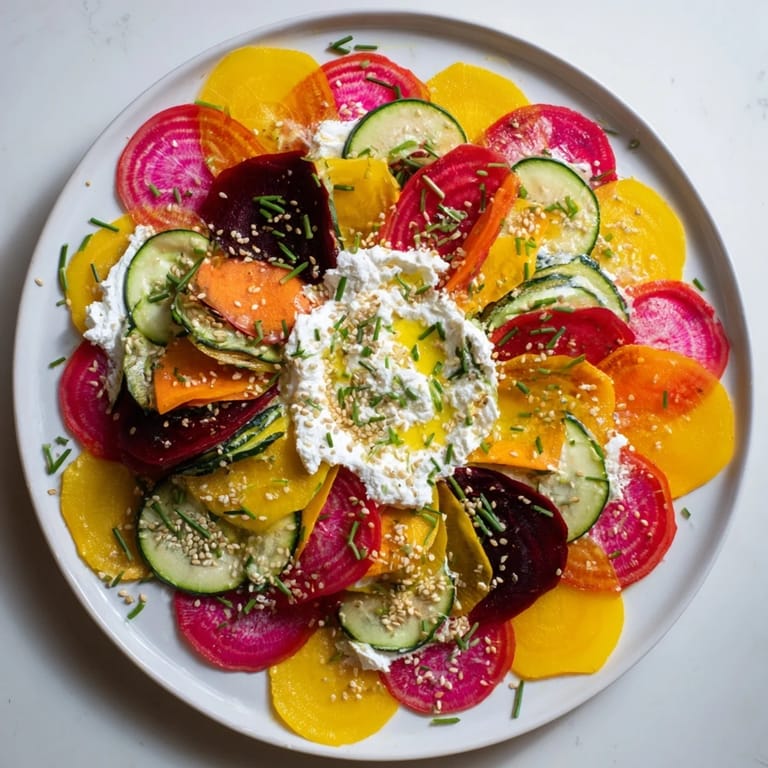
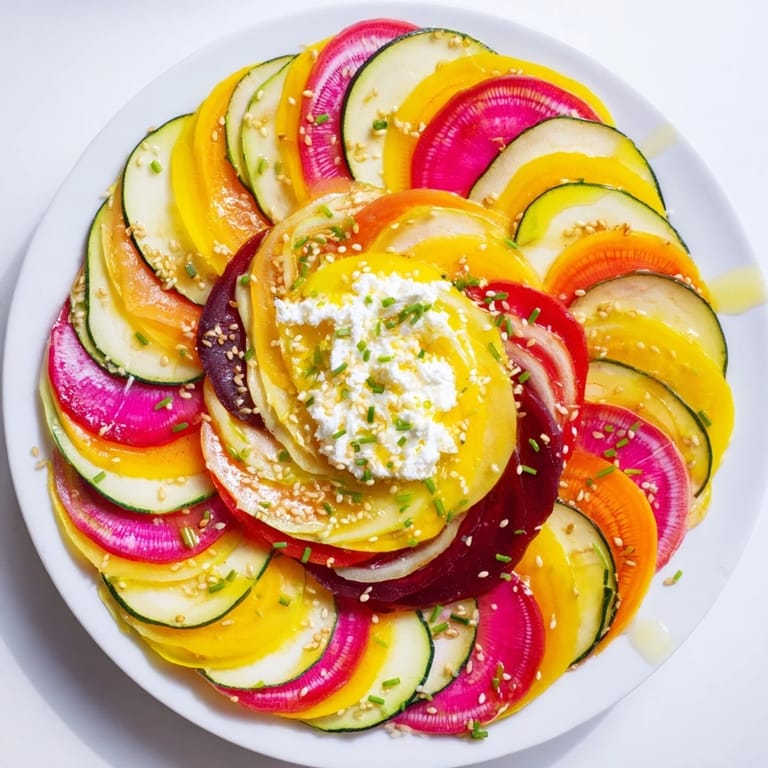
- Start with your boldest color—I usually begin with the deep red beets. Take a slice, overlap it slightly with the next, and fan them out like rays of sun. Watch how they naturally want to curve. Let your hands follow that instinct. Overlap each new slice just enough to catch the light between the layers.
- Build in rhythm:
- Alternate your vegetable colors as you move around the circle: red beet, then yellow squash, then carrot, back to golden beet. This isn't random—it's a visual conversation where each color amplifies the ones beside it. Before you know it, you'll have created something that looks like it took hours.
- Honor the center:
- Remove that guide bowl and take a moment. This is the moment it becomes real. Mix your goat cheese with crème fraîche until it's spreadable, then gently fill that empty circle. I think of it as the heart of the flower finally beating.
- Whisper the dressing:
- In a small bowl, whisk together olive oil, lemon juice, honey, salt, and pepper until they're friends. Drizzle it across the vegetables with a light hand—you want to kiss them with flavor, not drown them.
- Add the finishing magic:
- Scatter the chives over everything like green confetti, then sprinkle sesame seeds where they catch your eye. If you have edible flowers, this is where they complete the poetry.
- Serve with confidence:
- Bring it to the table immediately. There's a moment when everything is perfect—the vegetables haven't wilted, the cheese is still creamy, and the arrangement is still pristine. That's your moment.
 Pin It
 I'll never forget my friend Elena's reaction when she saw this for the first time. She actually gasped—like she was seeing art she'd wandered into at a gallery opening. In that moment, I understood that food isn't just about taste; it's about creating a memory that starts with your eyes before your mouth even catches up.
The Magic of Vegetable Arrangement
There's something profoundly satisfying about arranging vegetables in a deliberate pattern. It forces you to slow down and really look at what you're working with—the subtle color variations in a golden beet, the natural curves of a zucchini slice, the hidden geometry in a watermelon radish. When you take time to truly see your ingredients, they somehow taste better. It's like you've built a relationship with them before they even reach your mouth. I think that's why people linger over this dish. They're not just eating vegetables; they're experiencing the intentionality that went into every single placement.
Pairing and Serving Suggestions
I've served this as an appetizer before more elaborate meals, and it honestly sets such a beautiful tone that the main course has big shoes to fill. It also works beautifully as a light lunch on its own, especially with some crusty bread to soak up the lemon-honey dressing. The original notes mention Sauvignon Blanc, and I absolutely agree—that crisp, grassy wine is like the perfect dance partner. If you're not a wine person, a very cold sparkling water with fresh mint does something magical here too. The point isn't what's in the glass; it's that you're slowing down enough to really taste what's on the plate.
Variations and Substitutions
This is a recipe that genuinely invites creativity. I've used heirloom carrots in shades of purple and white, added paper-thin slices of cucumber for extra freshness, and sometimes I use ricotta instead of goat cheese for a softer, milder profile. Feta works beautifully too if you want something saltier. The core principle is simple: contrast colors, keep the arrangement symmetrical, and choose flavors that make sense together. Once you understand that framework, the specific vegetables become less important than the philosophy of putting thought into your presentation.
- Try adding thinly sliced purple cabbage for a peppery note and deeper color
- Substitute crème fraîche with Greek yogurt for a tangier, lighter version
- If sesame seeds aren't your thing, toasted pumpkin seeds or pine nuts work beautifully
 Pin It
 Every time I make this dish, it reminds me that the simplest ingredients become extraordinary when you treat them with respect and arrange them with intention. That's the whole philosophy right there.
Recipe FAQs
- → What vegetables work best for the sunburst arrangement?
Thinly sliced golden beet, red beet, zucchini, yellow squash, watermelon radish, and carrot provide vibrant colors and textures ideal for this presentation.
- → How can I achieve thin, even slices?
Using a sharp knife or mandoline helps create uniformly thin slices for an elegant, layered sunburst effect.
- → Can I substitute the goat cheese?
Ricotta or feta can be used in place of goat cheese, offering a similar creamy texture with slight flavor variations.
- → What is the purpose of the central bowl during assembly?
The bowl marks the center, allowing you to fan out the slices in perfect concentric circles before filling the space with the cheese mixture.
- → How can I enhance the salad's flavor?
The dressing of olive oil, lemon juice, honey, salt, and pepper adds a bright, balanced flavor complementing the earthiness of the vegetables.
- → Are there garnish options to consider?
Fresh chives, toasted sesame seeds, and edible flowers enhance both visual appeal and subtle flavor notes.